Showing posts with label #52Ancestors. Show all posts

Sunday, June 14, 2026

Possibilities - The Parents of Abram Beebe

The parents of Abram Beebe have remained a mystery over the years. Multiple trees list Joel Beebe and Mary Hale as parents. Not a single tree had any proof of this, but I recently discovered possible evidence pointing to these parents.

Abram Beebe was probably born in December 1822, and probably in Tioga County, New York. Around 1840, he married a woman named Lovisa or Louisa. It is possible that her surname was Castline. Abram died on 12 April 1895 in Candor, Tioga County, New York. His grave site has not been located, but he may have been buried in Maple Grove Cemetery in Candor. Abram and Lovisa had at least seven children - the line I'm tracking goes through his son Clark.

Abram was a millwright and spent his life in and around Tioga County except for a short stay in nearby Tompkins County and a possible brief foray into nearby Broome County. There isn't any indication that he was born or lived anywhere other than New York. 

JOEL BEEBE, WHO SERVED IN THE REVOLUTIONARY WAR

Joel Beebe was born about 1757, possibly in Connecticut. He may have married Mary Hale in Derby, Connecticut, in February of 1823, but was surely married for the first time before that. His death date is unknown, but it may have been 1839. 

Joel enlisted as a Private in the Revolutionary War in April 1777 and served for more than six years. He was in the Company commanded by Captain Charles Pond in Colonel Meigs Regiment of the Connecticut Line. He then transferred to the Second Connecticut Regiment, commanded by Colonel Swift, and served until the close of the war. He applied for a pension in March of 1818. 

In July of 1820, he stated that he was 63 years old, a resident of Derby, Connecticut, and had no property or securities. He listed his occupation as a farmer and basket maker. and stated that he had a wife who was "feeble and infirm, being troubled with dropsy" and an 18-year-old child. All his personal property was valued at $45.13. 

Another page of his pension application, which may have been added when his wife applied for a widow's pension, gave the following information.

  • Joel Beebe was a resident of Milford, Connecticut
  • He married (no date given) Mary Beebe, who was born 1783/4. 
  • Mary died March 21, 1874, aged 90 years, 11 months, and 21 days in Iowa. 
  • Children were listed as follows on an undated piece of paper. (A second similar listing is stamped 1923, so it was added to the file at a much later date.)
    • David Beebe, born 1808-10, died 1891 in Iowa. Married Nancy Heaton.
    • Fannie Beebe married Elijah Bills.
    • Mary Beebe married Elliott Foster and lived in Tioga County, New York.
    • Abram Beebe lived near Candor, New York. (The list that is stamped 1923 states that Abram was unmarried.)
The pension file appears to confirm that an Abram was the son of Joel. But there are several red flags.
  • First, in his pension application, Joel makes it clear that his wife is "feeble and infirm." That wife's name is never mentioned in the file. This, and the fact that they have an 18-year-old child, implies that she is older.
  • There is a marriage record on 1 February 1823 in Derby, Connecticut, for Joel Beebe and Mary Hale. Does this mean his first wife died and he remarried? Or is this a totally different Joel Beebe? The record is unclear, but this is the couple usually given as Abram's parents.
  • Is Abram a product of this second marriage, or are there multiple Abrams? 
  • If Joel married in February of 1823 in Derby, Connecticut, did he then move to Tioga County, New York? Abram's birth date is often given as 1 December 1822, but census records vary it from 1820 to 1827, so he may be a child of this marriage. 
  • There is still a Joel Beebe in Derby, Connecticut, in the 1830 census. The family makeup is 1 white male, 70-79; 1 female, 60-69; and 1 female, 30-39. This does not seem to fit with Joel losing one wife and then remarrying Mary Hale, who would have been only about 47 at the time. But it does fit with having an older wife. It's unclear who the younger female is.
So, did everyone assume that the Abram referred to in this pension file was Abram who married Lovisa? The Candor residence certainly points to him. But the biographical information was written later, not by Joel himself, and its source is unclear.

And, on top of all that, there is a second Joel Beebe who looks interesting. He was a 70-year-old living in Covington, Tioga County, Pennsylvania, in 1850 (just over the border from New York). And he is a miller!! Oddly enough, this particular Joel Beebe and his wife, Elizabeth, ended up moving to Minnesota, and he is buried about 15 miles from my house. 

So that gives me a long list of things to look for. This list includes: 
  1. Are there other Abram Beebe born in the period of about 1820-1827, particularly in Tioga County, New York? Or any born earlier that would fit in with the patriot Joel? 
  2. Both Joel Beebes had children, and they need to be tracked and confirmed. 
  3. More information about the Pennsylvania Beebe needs to be found. Because he was a miller -- and Abram was a miller --- there could be some connection. Often, these occupations were passed down from father to son. 
  4. Are there other candidates for the father of Abram? Were there other Beebes living in Tioga County, New York? Check both the 1820 and the 1830 census. 
  5. Make sure to learn everything about Abram Beebe, including land purchases, probate records, newspaper articles, etc. 
There is obviously a lot more work to be done before I can rule anyone in or out. 

NOTE: Most of the information above is sourced. Contact the author for more information regarding these sources and Abram Beebe.

___________________________________________________________
This week's #52Ancestors Prompt is POSSIBILITIES

Wednesday, February 18, 2026

Those Big Decisions That My Relatives Made

This week's #52Ancestors prompt, Big Decisions, got me thinking about 

decisions made by relatives that impacted their lives.

My maternal grandmother, Stella Edwards Butzek, made the decision as a young woman to move to Chicago to find work. This turned out to be a good decision as she met and married my grandfather, Anthony Butzek. As a young married couple with a young child, they made the decision to move to southern Illinois, where Anthony farmed and worked the coal mines. After Anthony's untimely death in a mining accident, my grandmother made the decision, yet again, to move to Chicago where she spent the rest of her life.

My paternal grandparents, George Michael Martin and Florence Halliday Martin, made the decision to move from Albia, Iowa, to West Frankfort, Illinois, as newlyweds. It's not clear what prompted this decision, but I suspect the coal mines in Iowa were close to being played out, and they saw a better financial future in southern Illinois. They raised two children and spent the rest of their lives in West Frankfort.

I had several relatives who made the big decision to immigrate to the United States. These included my grandfather, Anthony Butzek, who came over in 1909 with his family. He was just a toddler and obviously had no say in the matter, but his parents made that decision. Perhaps it was for a better life; perhaps there were legal issues in the old country, as the family stories suggest. 

My paternal Halliday great-grandparents moved from County Durham, England, to Iowa, from one coal-mining area to another. And it was a successful move. My paternal Clark great-great-grandparents moved from Lanark County, Scotland, to Iowa, stopping first in Ohio. Despite the challenges, life was reasonably good for them. 

Further back in time, I had relatives who decided to move westward. They moved from North Carolina to Tennessee and Kentucky, finally ending up in southern Illinois, although some ended up in Texas and Oregon. 

What caused all these people to pack up and make these moves? More land, better opportunities, anti-slavery sentiments, or a combination of things that made the decision easier? Did they have so little that packing up and moving wasn't a big deal? I can't answer these questions—I can only speculate. Whatever the reasons, I am grateful for these moves. Because in the end, it gave me a better life!

Tuesday, February 3, 2026

Favorite Photo - with Grandma and Grandpa Martin

One of my favorite photos has always been this one. It was taken in early 1952. The photo is of my grandparents, George Michael "Mike" Martin and Florence Halliday Martin, holding their first grandchild - me!!

My grandparents were a handsome couple. They were in their early 50's in this photo. It was likely taken in front of their home in West Frankfort, Illinois, and based on the way we are dressed, it was likely in the spring of that year. I think they both look proud of their granddaughter, and I hope I've made them proud over the years by telling their stories!

___________________________________________________

This Week's #52Ancestors Prompt is Favorite Photo.


Monday, January 5, 2026

A Colorful Tale

Early in my research, I was surprised to learn that my paternal grandmother had been married before marrying my grandfather. It was one of those family secrets that people don't talk much about, but they assume you know.

I obtained a copy of the marriage record. Dated 25 January 1916, Florence Halliday, age 16, was married at Eldon, Wapello County, Iowa, to H.W. Edwards, aged 24. H.W., whose name I learned was Harold, was listed as a salesman.[1] Although my grandmother was listed as aged 16, she was born on 15 February 1897 and was therefore almost 19 years old.[2] It's unclear why the age was incorrect.  

What made this marriage colorful (besides being puzzled about the listed age) was reported in a newspaper article I found about the wedding.

"Married in Eldon," The Gazette (Cedar Rapids, IA), 
1 February 1915, p.2, col.3. From newspapers.com.


First, it was noted that Florence's new husband had given up a theatrical career, although he was employed by a company that likely made theatrical scenery. Is this what attracted her to him in the first place?

Secondly, the marriage took place on stage during the last act of the play $1 for a Kiss. That had to have been an extraordinary wedding ceremony. The play was written by Moore and Watterson. J.G. Moore was listed as a witness to their marriage, along with J.M. Baker. Were they both actors in the play? No record of a play by that name has been found, so it was likely just a local production. 

Their wedding reception was a banquet given by the "Sons of Rest". This appears to be a social group, perhaps formed around theater people. There doesn't seem to be any formal group by that name. 

Eight months later, a son was born—Richard Eugene Edwards.[3] This was another family secret. It's unclear what illness Richard had, but it was some sort of chronic disability. He spent most of his short life living with his Halliday grandparents. Richard died on 12 September 1934 in West Frankfort, Franklin County, Illinois, aged 18. He was listed as an Invalid.[4] 

The Halliday-Edwards marriage didn't last very long either. The final divorce decree was issued on 1 May 1919 in Albia, Monroe County, Iowa. Florence was awarded custody of Richard and child support of $12 a month.[5] 

Harold didn't waste any time remarrying. On 6 May 1919 in St. Louis, Missouri, he married Miss Blossom Cheek of Decatur, Illinois.[6] That marriage also didn't last very long. Harold died on 2 December 1930 in Jacksonville, Illinois.[7] 

Harold was a mysterious person. In addition to his early theater career, his name was often listed differently. He usually went by H.R. Edwards, occasionally Harold. But when he married Florence, he was listed as H.W. Edwards. He appears to have established himself as a salesman until his death. His birth date is given as 4 September 1893 on his World War I draft registration.[8] His tombstone agrees to the day and month but lists the year as 1894.[9] His obituary lists his birth date as 9 September 1891.[10] But even if you use the earliest year, he died young, before he was forty years old.

Harold was not the only family member who went on the stage. His brother Charles had toured the country in various productions. He also died before he was forty.[11]

My grandmother married George Michael Martin on 12 September 1925 in Albia, Monroe County, Iowa.[12] They lived there for a couple of years before moving to West Frankfort, Illinois, where they lived a fairly routine life.

Florence Halliday Edwards Martin died 10 July 1967 in West Frankfort, Franklin County, Illinois, of congestive heart failure.[13] She left no sign of her early, colorful life.
________________________________________________________

The #52 Ancestors Prompt for Week 2 is A Record that Adds Color
________________________________________________________

SOURCES:
    [1] “Iowa Marriage Records, 1880-1947,” digital image, Ancestry (https://www.ancestry.com/discoveryui-content/view/3998653:8823: accessed 7 June 2023); Wapello County, p. 90-93, #1454, Edwards-Holiday, January 1916; Iowa Department of Public Health.
    [2] Clerk of the District Court, Keokuk County, SIgourny Iowa. Copy received from grandmother’s files. Florence Halliday, 1897, Keokuk County.
    [3] Birth record not found. Date of birth from: “Illinois Deaths and Stillbirths, 1916-1947,” database, FamilySearch (https://www.familysearch.org/ark:/61903/1:1:NQ1J-SRQ: accessed 8 June 2023), Richard Eugene Edwards, 12 September 1934, Franklin County,; Public Board of Health, Springfield, FHL microfilm 1,712,057, image #948.
    [4]“Illinois Deaths and Stillbirths, 1916-1947,” database, FamilySearch (https://www.familysearch.org/ark:/61903/1:1:NQ1J-SRQ: accessed 8 June 2023), Richard Eugene Edwards, 12 September 1934, Franklin County,; Public Board of Health, Springfield, FHL microfilm 1,712,057, image #948.
    [5] “Court Records, v. 31, 29 April 1918-29 Oct 1920,” digital image, FamilySearch (https://www.familysearch.org/ark:/61903/3:1:3Q9M-CS4R-GXYD : accessed 8 June 2023); District Court, Monroe County, Iowa, Record No. 31, p. 235, April 1919 term, 1 May 1919, #9819, Divorce Decree Florence Edwards, Plaintiff vs. H.R. Edwards, Defendant.
    [6] “Cheek-Edwards,” Herald and Review (Decatur, IL), 9 May 1919, p.9, col. 4-5; digital image, newspapers.com (https://www.newspapers.com: accessed 9 June 2023).
    [7] “Illinois Deaths and Stillbirths Index, 1916-1947,” database, Ancestry (https://www.ancestry.com/discoveryui-content/view/423029:2542: 9 June 2023); Jacksonville, 2 December 1930, Harold R. Edwards.
    [8] “World War I Draft Registration Cards, 1917-1918,” digital image, Ancestry (https://www.ancestry.com/discoveryui-content/view/30810145:6482: accessed 9 June 2023), St. Joseph City, Missouri, Draft Card E, S, Harold Edwards.
    [9] Find a Grave, memorial #26082249, photo by kpet. Graceland Cemetery (Decatur, Macon County, Illinois), H. Robert Edwards Sept 4 1894-Dec 2, 1930.
    [10] “Decatur Resident Dies in Jacksonville,” Hearld and Review (Decatur IL), 3 December 1930, p.3, col. 6; digital image, newspapers.com (https://www.newspapers.com: accessed 9 June 2023).
    [11] “Charles Edwards, Actor, Is Dead at Fort Dodge: Wife and Family Here,” The Gazette (Cedar Rapids), 18 June 1918, p.3, col. 4; digital image, newspapers.com (https://www.newspapers.com: accessed 8 June 2023).
    [12] “Iowa, Marriage Records, 1880-1947,” digital image, Ancestry (https://www.ancestry.com/discoveryui-content/view/3193437:8823: accessed 9 June 2023); Monroe County, #94, 68, 012948, September 1926, Martin-Edwards; citing Iowa State Board of Health.
    [13] Death certificate, Florence Halliday, Franklin County, Illinois. Copy in author's possession.


Thursday, January 1, 2026

The Ancestor I Admire The Most

There are many ancestors I admire. They didn't do anything important - they just survived, and in my mind, that's something to be admired. My grandmother was one of those who endured many trials and tribulations. She did not have an easy life. 

Stella May Edwards was born on 23 July 1912 in Williamson County, Illinois. Her parents were George Elmus Edwards and Olive Isabel Pogue. Stella was ten years old when her father died in March of 1923, leaving her mother to raise the three remaining children. Her little sister Hazel had been killed in a horrible fire just a couple of years before. 

Stella's mom remarried in 1926 to Joseph Kehder. That marriage produced a half-brother, Richard Eugene "Gene" Kehder, who remained close to his half-sister until her death, even after the marriage ended in divorce. Olive Pogue went on to marry at least one more time, possibly two. She lived until 1959. 

My grandmother moved to Chicago to find work sometime around 1930. There she met and married Anton Martinek/Butzek. (He legally changed his name to Butzek, the name of his stepfather, when he was naturalized in 1943.) The couple stayed in Chicago for a couple more years, where my mother was born. They moved back to southern Illinois by 1935, where a son was born in 1939. 

Life was hard in southern Illinois during the depression. My grandfather farmed during the day and worked in the coal mines in his spare time. He learned to farm by reading books on agriculture, and apparently, he had one of the more prosperous farms in the area. But even that wasn't enough. He was working on a WPA road crew in 1940. Things were only going to get worse.

In November of 1943, my grandfather was killed by a falling piece of coal while working in Old Ben Coal Mine #15 in Franklin County, Illinois. My grandmother and her two young children stayed in southern Illinois for some time. (My mom was ten, my uncle just three.) They moved into town, and my mom graduated from West Frankfort High School. My grandmother didn't actually sell the farm until many years later.

Sometime after 1950, the family moved to Chicago so my grandmother could find work. She worked at a meat company near the stockyards for a while, then moved to Goes Lithographing as a secretary. She held that job for many years until her "retirement." 

Early in my life, my parents bought a small house in Dolton. My grandmother and Uncle Tony lived in a small upstairs apartment. I always felt lucky that they were close by. I used to go upstairs every night and brush my grandmother's hair. I assume she found it relaxing, but I remember it as being a way to bond with her. 

Even after my grandmother retired, she still did odd jobs. She often "looked after old ladies," as she described it—sitting with them and taking care of them. She moved from her small Roseland apartment to a basement apartment in Blue Island. She kept active in her church and had many friends. 

My grandmother died on January 1, 1989. She had gotten in her car to go to church. Her Bible was on the seat next to her. It was sudden and unexpected. She was only 76 years old. 

My grandmother never did anything extraordinary. She just went to work every day to support herself and her children. She never remarried, having lost the love of her life early on. She loved her church. She loved her grandchildren, and I was happy that my sons, her first great-grandchildren, got to know her a little bit. Her life was not unlike that of many of my other ancestors, admired for how they faced life's daily challenges.

The first #52Ancestors Prompt of 2026 is An Ancestor I Admire

Friday, December 12, 2025

Family Heirlooms

I'm always jealous of folks who have inherited a lot of family heirlooms. I have very few, so I treasure the ones that I have, even though they are not very old.

I inherited my paternal grandmother's hutch.[1] It is likely about 75 years old and sat in my grandparents' kitchen in southern Illinois. At one time, there was a matching table and chairs, but these are long gone. The only thing I remember that sat on the hutch was a radio. I can still picture my grandmother listening to that radio as she prepared meals. She always listened to the lists of people who were hospitalized or who had passed away. When she heard mention of someone she knew, she'd yell into the living room to my grandfather to tell him. That was the social media of the time. Today, the hutch sits in my living room, filled with genealogy books on the top shelves and serving dishes in the bottom. 

A second treasured heirloom is a pocket watch. This belonged to my dad, but I believe it was handed down to him from his English grandfather.[2] He was a little vague. For some reason, I always admired this watch. As a child, I'd take it out of the drawer and look at it. It was the one thing I wanted. I mentioned that to my parents during one visit. There was a bit of pushback as my dad thought it should go to my brother. But my mom made sure to give it to me before I left.

I have one other heirloom. I have no idea how old it is or where it came from. It's a small, opal-like ring that had belonged to my maternal grandmother.[3] I never saw her wear it -- she wasn't one to wear jewelry. I didn't even know she had it, but I got a bunch of her jewelry after her death, and the ring was among the other things. The stone appears to be slightly cracked. But I've worn it to every job interview and consider it my lucky ring. 

My family were poor farmers and coal miners. They had very little. But the few items I have are wonderful reminders of the people they came from. And without knowing their actual stories, I can imagine more colorful stories!!

Genealogical Information

[1] Florence Halliday, born 15 February 1897, What Cheer, Keokuk, Iowa. Married 1) 25 January 1916, Eldon, Wapello, Iowa, to Harold R. Edwards. Married 2) 12 September 1925, Albia, Monroe, Iowa, to George Michael Martin. Died 10 July 1967, West Frankfort, Franklin, Illinois

[2] Robert Halliday, born 21 April 1867, Carrville, Durham, England. Married 25 December 1893, Appanoose County, Iowa, to Margaret Lafferty Clark. Died 3 August 1933, Albia, Monroe, Iowa.

[3] Stella Mae Edward, born 23 July 1912, Corinth, Williamson, Illinois. Married 9 May 1931, Chicago, Cook, Illinois, to Anton Martinek/Butzek. Died 1 January 1989, Blue Island, Cook, Illinois. 

-----------------------------------------------------------------------------------

This week's #52 Ancestors prompt was Family Heirloom.


Wednesday, December 3, 2025

Letters to the Editor

Currently, I have a couple of friends who regularly write letters to the editor. One is a genealogist, the other a lawyer. They are always interesting, well-written letters that convey opinions better than I ever could.

But my favorite letter to the editor remains the one my friend Steve wrote when he was 10 years old. It was written in 1955  to the editor of the Ithaca Journal  regarding a crossword puzzle clue.  I will willingly admit that there's no way I could have written such a letter at the age of 10. And, in case you wondered, Steve is still a very well-read guy - a habit he obviously learned early in life!!!


Ithaca Journal, 29 April 1955, p.6. From newspapers.com

_________________________________________________

This week's #52 Ancestors prompt was WRITTEN.


Saturday, September 27, 2025

Disappeared - Where did they go?

Some people just disappear without a trace. My Pogue line is filled with mysteries and disappearances.

Oliver Isabel Pogue (1910-1959) was my great-grandmother. Her life is reasonably well documented, although I might have missed a husband. (She was married at least three times.) But things start to get murkier with her father.

Josiah Pogue (1848-1900) had many names: Cyrus, Silas, Si, Cy, Joe, and Josirus. All are variations, and one can understand how these names evolve. In 1850, two-year-old Josiah was living with his parents in Franklin County, Illinois. They are enumerated as Jas and Nancy Pouge. He has three older siblings: Wm. R., age 10, and Geo. W. age 7 and L.E. age 3, who was the only girl. (1)

And then James and Nancy Pogue disappear. In 1860, Josiah, then 12, was living with John M Foster, his wife, Sarah, and their five children. (2) John and Sarah had lived next door to the Pogues in 1850. 

But in 1870, Josiah vanishes. No record has been found of him. As a matter of fact, several neighbors appear to be missing, so it's likely their little hollow was just missed in the enumerators' trek.

In 1880, Josirus, now aged 23, is living with William Foster and his wife. William was the son of the above John Foster, and Josirus is listed as a cousin. (3) So was there a relationship? In 1886, John Foster, who is a minister, married Josiah Pogue and Mahala McClerren.(4) 

So what happened to Josiah's parents? His father James, has always been a bit of a mystery. Was he married three times or just two? Wives may have been Nancy Taylor, Lydia Medlin, and Nancy Plaster. James served in the Black Hawk War along with others from Franklin County. (5) He moved around, living in Saline, Gallatin, and Franklin Counties. He appears to have purchased land in Franklin County in 1851. (6) 

So the mystery grows. Later in 1851, there is a court record that I believe is for James. William Foster (not the same William Foster that Josiah lived with in 1880) went to court to state that James Page, father of George W, aged 9, Lyenin aged 7, and Josiah Page, aged 4, "has for six months last past wilfully neglected to provide for his minor children." He was found guilty, and Joseph Swafford was appointed guardian. (7) This record was an abstract, and I haven't yet tracked down the original. But this would indicate that James's wife had died and he was having trouble taking care of the children. 

In April 1852, James sold his land in Franklin County.(8) And that's the last of the records I've found for James Pogue. In 1852, he would have been 45 years old. So where did he go? Did he die? I'm assuming, with no proof, that his wife Nancy had died, perhaps in childbirth, after the 1850 census. 

It is possible that James Pogue had two older sons, likely by one of his first wives, David and James. Their lives are a bit of a mystery. Son William R Pogue moved to Lane County, Oregon, by 1860. (9)  He married, had a family, and died at the age of 80, in the Oregon State Insane Asylum.  (10) 

His son, George W Pogue, isn't found in the 1860 census but enlisted in the Civil War. He was court-martialed for selling bootleg liquor in Vicksburg, Mississippi. After the war, he lived in New Mexico, probably working in a gold mine, then moved to Montana as a miner. (11) By 1910, he was living in Malibu, California, in the Pacific Branch of the National Home for Disabled Volunteer Soldiers.(12) He had a couple of run-ins with the law and eventually ended up in the Leavenworth Soldiers' Home, where he died in 1918. ,(13)

L.E. Pogue is a real mystery. The only female in the family, it's unclear what her name even was. Some say it was Lydia but normal searches have not turned up good candidates. She was three in 1850. Did she die soon after? It appears that she was mentioned in her father's court case in 1851, listed in the abstract as Lyenin.

So where did all these people vanish to? William and George vanished from southern Illinois, but they are both trackable. Josiah is trackable except for 1870. So what happened to the rest of this family? Where did they go? And more importantly, why? These are mysteries that may never be solved.

This week's #52 Ancestors prompt is DISAPPEARED.

(1) 1850 U.S. Federal census, Franklin County, Illinois, population schedule, p. 34b, dwelling 482, family 496, Jas Pouge household; digital image, Ancestry (https://www.ancestry.com/imageviewer/collections/8054/images/4193355-00269: accessed 10 October 2021).

(2) 1860 U.S. Federal census, Franklin County, Illinois, population schedule, Township 7S, Range 4E, p 495, dwelling and family 977, Josiah Pogue in John M. Foster household; digital image, Ancestry (https://www.ancestry.com/discoveryui-content/view/37996966:7667: accessed 20 May 2024).

(3) 1880 U.S. census, Franklin County, Illinois, population schedule, Cave township, e.d. 16, p. 7, dwelling 54, family 54, William A. Foster household; digital image, Ancestry (https://www.ancestry.com/discoveryui-content/view/21070843:6742: accessed 5 April 2023).

(4) “Marriage Records, 1878-1916,” Digital image, FamilySearch (https://www.familysearch.org/ark:/61903/3:1:939J-KM94-N6: accessed 10 October 2024); Franklin County, volume 1, p. 129, License #1617, 1886, Pogue-Striplin marriage. FHL #4661221/1005307, Image 141 of 521. 

(5) Elliott, Isaac H., Record of the Services of Illinois Soldiers in the Black Hawk War 1831-32 and in the Mexican War 1846-48 (Journal Company: Springfield, 1902). P.8-9.

(6) James Pogue (Franklin County) scrip Warrant file, certificate #14503 (1851), Shawneetown, Illinois, Land Office; Issue Date 10 December 1851; digital image, Bureau of Land Management (https://glorecords.blm.gov/details/patent/default.aspx?accession=0604-156&docClass=MW: accessed 10 October 2024).

(7) Pulliam, Carla, comp. Early Court Records, Franklin County, Illinois (Self-published, 1995). V. 1 1836-1876, V 2, 1877-1900. 

(8) “Deed Record: Franklin. Deeds, 1832-1853,” digital image, FamilySearch (https://www.familysearch.org/ark:/61903/3:1:3Q9M-C37S-QS6F-M: accessed 8 October 2024); Volume D, p. 571-572, 1852, James Pouge Deed to Handovus D. Johnson; FSL Film 8571267, Item 3, Image 306 of 324. 

(9) 1860 U.S. census, Lane County, Oregon, population schedule, Springfield Precinct, p. 11[?], sheet 284, dwelling 544, family 544, Sarah Powers household; digital image, Ancestry (https://www.ancestry.com/discoveryui-content/view/43982636:7667: accessed 16 January 2023).

(10) “Oregon, State Deaths, 1864-1968,” digital image, Ancestry (https://www.ancestry.com/discoveryui-content/view/330761:61675: accessed 18 September 2022); entry for Wm R Pogue, Marion County, 7 February 1921.
 
(11) 1870 U.S. census, Colfax County, New Mexico Territory, population schedule, Precinct #1, p. 14, dwelling 246, family 206, George Pogue household; digital image, Ancestry (https://www.ancestry.com/discoveryui-content/view/39418625:7163: accessed 16 January 2023). Also, 1880 U.S. census, Lewis and Clark County, Montana, population schedule, Belmont, page 36, e.d. 19, dwelling 362, family 365, George Pogue in R. Woolcox household; digital image, Ancestry (https://www.ancestry.com/discoveryui-content/view/15221305:6742: accessed 16 January 2023).

(12) 1910 U.S. census, Los Angeles County, California, population schedule, Malibu, e.d. 288, sheet 10b, Family #, Pogue, George W, inmate; digital image, Ancestry (https://www.ancestry.com/discoveryui-content/view/1271263:7884: accessed 4 August 2022).

(13) “Tells the Police Officers What He Thinks of Them,” Evening Vanguard (Venice, CA), 15 June 1914., p.1, col. 3; digital image, newspapers.com (https://www.newspapers.com: accessed 16 January 2023). Also, “U.S., National Homes for Disabled Volunteer Soldiers, 1866-1938,” digital image, Ancestry (https://www.ancestry.com/discoveryui-content/view/17319:1200: accessed 16 January 2023); Registers of Members, Leavenworth, Kansas, #22307, George W. Pogue, admitted 3 October 1908; Citing NARA Series M1749.  For death, “Burial Registers, Military Posts and National Cemeteries, 1862-1960,” digital image, Ancestry (https://www.ancestry.com/discoveryui-content/view/446241:3135: accessed 4 August 2022); Leavenworth National Cemetery. 1918, George W. Pogue; citing The National Cemetery Administration: Leavenworth National Cemetery Death Records, Western Branch N.H.D.V.S. 1808-1929, 1932-1936, Records of the Department of Veterans Affairs, 1773-2007, Record Group 15, NARA.


Thursday, September 4, 2025

Off to School -- but the Russians are coming!!

Starting kindergarten in 1956, I found myself in the middle of the Cold War. I don't remember talking much about current events in school, and we certainly had no understanding of the Cold War. We received the Weekly Reader, which covered some current events on a high level, and we were vaguely aware of "the Russians." But we were taught to fear them. 

There was always the chance that "the Russians" would bomb us. So we practiced 'duck and cover' exercises. At a pre-arranged time, we were signaled to 'duck and cover.' There were two ways we did this. In some classes, we would get under our desks and cover our heads. In other classes, we would go out into the hallway, back to the wall, crouch down, and cover our heads. We were told to especially cover our eyes to avoid seeing the "flash." I'm not sure we ever knew what the flash was. All this was especially difficult for the girls - there was no such thing as wearing slacks in those days -- we were always in dresses. 

Of course, as we learned later, 'duck and cover' wouldn't have protected us from a real nuclear bomb if it had fallen on us. I'm not sure if people initially thought this was some kind of protection or if they just wanted to scare us. 

These drills were scary at first, but they eventually just became routine and a way to avoid classes. I don't remember when the drills stopped, but it was likely sometime in the early 1960s. But a whole generation of kids remembers these drills and our fear of "the Russians." 

This week's #52Ancestors prompt is Off to School.

Thursday, July 17, 2025

Cousins (or lack of)

This week's #52 Ancestors topic is COUSINS. So I set out to figure out how many cousins I might have.

FIRST COUSINS: I only have two first cousins. They are the same ages as my sons, one even being born on the same day as my oldest son, but about 10 hours earlier. 

This piqued my interest in the number of other cousins I had, so I ran a report from Legacy. Here's what I learned:

  • 1C - 2
  • 1C1R - 50
  • 1C2R - 118
  • 2C - 33
  • 2C1R - 27
  • 2C2R - 94
  • 3C - 2
  • 3C1R - 7
  • 3C2R - 58
  • 4C - zero
  • 4C14 - 2
The numbers were interesting to me as I've always been envious of people who had a lot of cousins. I didn't know most of my cousins, and those I did know, I rarely saw. This is probably why I struggled to write a blog post about cousins. However, through my research, I have come to know most of their names and have learned a bit about many of them. 

Wednesday, June 25, 2025

My Favorite Names

 This week's #52Ancestors Prompt is FAVORITE NAMES. 

I have some favorite names that I'm researching, but a couple are unusual and interesting and always make me smile.

The first is Cinderella Breedlove, my friend Sharon's 3rd great-grandmother. I always wonder where her first name really came from. I've seen a photograph that is supposedly her; she looks like a prim, unsmiling woman. But the name is just fun.

Cinderella Breedlove was born in March of 1800, likely in Albemarle County, Virginia. She was the fourth child of Martin and Elizabeth (Carr) Breedlove. Except for her sister Permilia, all the other siblings had common names, such as John, Sarah, Elizabeth, and Thomas. So what made her parents come up with the name of Cinderella, which is often spelled with an S?

Cinderella married in 1820 in Warren County, Kentucky, to Thomas Richard Lowry. The family moved around 1829 to Lebanon, Laclede County, Missouri, where they remained. Cinderella died on 22 April 1858 in Laclede County and is buried in the Old Bolles Cemetery. She and Thomas had twelve children, all of whom were given common names. 

Another name I like is Clinkenbeard. This surname is found in both my friend Sharon's family and my daughter-in-law's family. And it turns out they are related. The name is sometimes spelled Clinkingbeard, which always conjures up a picture of an old man with a long beard. 

In my family, there aren't any favorite last names, but I do have various aunts with interesting (yet typical for the time) first names. There is America, Tennessee, and Missouri. There are many in my family, like others, who are named after political and military persons. I have a Henry Clay Rains and a Winfield Scott McClerran. There are some named after notable figures such as Lorenzo Dow, George Washington, and Andrew Jackson, among many others. Learning something about the names sometimes gives me an idea of how the family leaned politically! But I still can't figure out where Cinderella came from. 


Friday, April 11, 2025

My Big Mistake

 This Week's #52Ancestors Prompt is Big Mistake

While I have made many mistakes in my genealogical research, the biggest one was likely in researching my Clark line. I knew that my paternal grandmother’s mother was Margaret Clark. She married Robert Halliday in Iowa. Robert was a coal miner who was born in England. There might have been some connection to Pennsylvania, and it seemed her family also had coal mining roots. But I didn't know where the family came from or even when they arrived in this country. Pennsylvania and coal mines were the extent of my knowledge when I started. 

For some reason, Pennsylvania got stuck in my head, and I started researching Clarks in Pennsylvania. I had no specific location. Never mind that Clark is one of the most common names in the U.S.. Never mind that I knew nothing about Pennsylvania. Never mind that I barely knew anything about genealogical research. That’s where I focused. 

This was long before the internet, and I had few resources to turn to. I joined a Clark Family Association based in Pennsylvania and combed through each issue of their journal for a clue to my Clark family. Of course, I never found anything. I would have been better off throwing darts at a dartboard. This misguided research was a BIG MISTAKE. 

Except there was a nugget of truth to the story. 

Margaret Clark’s father was Alexander Clark.  He was born in Coaltown, County Fife, Scotland in 1834 to Alexander Clark and Grace Christie. Alexander and Grace never married, but Grace filed for child support. Alexander married Mary Callendar in October of 1854 in New Monkland, Lanarkshire, Scotland. He had already started working in the coal mines. They had six children born in Scotland before they moved to the United States in 1869. 

IN 1870, THEY WERE LIVING IN FAYETTE COUNTY, PENNSYLVANIA. So, there was that nugget. They moved to Trumball County, Ohio, where Margaret was born in 1872. By 1880, the family had relocated to Richland Grove, Mercer County, Illinois. At some point, they moved to Appanoose County, Iowa, where Alexander and Mary remained until their deaths. Alexander died in June of 1912. His wife, Mary, died in 1903. Margaret married 25 December 1893 in Appanoose County to Robert Halliday. She died in Chicago in 1948. 

The moral of the story is to make notes on all those bits and pieces you hear from your family. But until you have some evidence, don’t chase a common surname in a big state like Pennsylvania unless you know what you are looking for.


Wednesday, April 2, 2025

The Languages We Know (and Those We Don't)

Genealogists often need to have a basic understanding of more than one language. Besides reading old handwriting, we read it in an unfamiliar language. Fortunately, we have tools to help us. 

I took four years of high school French, and it turned out that I’ve been able to put that to good use. My sons have deep French-Canadian roots. Records in Quebec - and some in Kankakee County, Illinois, where they ended up, are all in French. With the help of a good dictionary, a French word list from Family Search, and Google Translate, I’ve read most of the records I’ve encountered. Add in using Transkribus and other AI tools, and it all becomes even easier. 

One of the things I’ve found most helpful is ensuring I understand what I’m looking at. To that end, the book French Language Lifelines for the Anglo Genealogist by Sandra Goodwin has proved to be just that - a lifeline. It has helped me decipher unknown words, understand what information is typically included in specific records, and provided additional word lists. If you are doing French-Canadian research, I highly recommend it. (Thanks to David Ouimette for telling us about this book!!) 

I started researching a friend’s roots in southern Colorado and New Mexico a couple of years ago. This was a new world for me. I took two or three quarters of Spanish in college, which helped me with the language. Again, word lists from FamilySearch and Google Translate have helped. I think two things will prove useful in helping me through the challenge of understanding Spanish documents. The first is George and Peggy Ryskamp’s book Mastering Spanish Handwriting and Documents - 1520-1820. The second is the BYU handwriting tutorial, which covers various documents. And again, Transkribus and AI will likely prove to be helpful. 

I’ve got several German families I’m researching - my own and other projects I’m working on. German was out of my wheelhouse, so I did about six months of DuoLingo German language. Of course, six months isn’t long enough to learn a language, but it gave me some basics - sentence structure, vocabulary, and familiarity with the language. I think this fundamental knowledge has helped, again, along with all the standard tools, in deciphering German documents. 

The other language(s) I’ve tried to understand a bit of is Hebrew and Yiddish. I’ve got a couple of projects I’m working on with Jewish roots, and the language was a brick wall. A couple of years ago, I took a great Jewish genealogy course at SLIG coordinated by Emily Garber. There were great resources included, and I’ve got a few that, at the very least, can help me read tombstones (with a lot of work). I haven’t been brave enough to dig into other documents. And, of course, there’s often the challenge of many of the records being in Cyrillic. I don’t think I’ll be willing to dig into that in any depth. 

I’ve also encountered Polish, Czech, Norwegian, and Swedish documents as a genealogist. Each language has its challenges. Fortunately, we have all those great tools at our fingertips that can help us understand the basics of each document. The process remains the same for each language. Do your best to transcribe the document precisely as it is written - manually or using Transkribus. Then the document is translated using word lists, Google Translate and/or AI. Ensure you understand what you are looking at, what the document is about, and what information it might contain. Using all the tools we now have, genealogists can “read” almost anything. (Except for those written with very, very bad handwriting. Bad handwriting occurs in EVERY language.)

The #52 Ancestor Prompt for this week was LANGUAGE.

Tuesday, March 18, 2025

The Day the "Black Monster" Came


One hundred years ago, on 18 March 1925, the United States’ deadliest tornado roared through Missouri, southern Illinois, and southern Indiana. When it was all over, 695 people were dead, over 2000 more were injured, and 15,000 homes were destroyed. Known as the Tri-State Tornado, this F5 storm destroyed entire towns as it made its way for over 200 miles. It lasted for almost four hours before it finally died out. 

Late in the afternoon, the “Black Monster,” as some newspapers called it, struck Franklin County, Illinois. It directly hit the town of West Frankfort, destroying the northwest part of town. West Frankfort was a town I knew well — both my parents grew up there, but my great-grandparents hadn’t yet moved from Iowa. My mother’s family lived on farms and in small communities outside town.  

As the storm hit West Frankfort, it destroyed Central School. The windows shattered, and everything crumbled. Children hid under their desks, and many were buried under the rubble for hours before being rescued. Parents raced to the school — some found their children alive. Others were not so lucky - at least 15 children were dead.

In the town of Orient, the Orient No. 2 coal mine was destroyed, killing many miners. While being in the mines provided some protection from the storm, the apparatus and buildings above ground were all destroyed. The tornado hit as a shift was ending. Miners coming to the surface were hurled into piles of rubble. Survivors described walking through the wreckage and seeing twisted steel and bodies. Many miners who had been underground throughout the storm came to the surface only to find their homes destroyed and their families dead. 

The City of West Frankfort https://www.westfrankfort-il.com/page/tornado-of-1925

The tornado destroyed entire neighborhoods throughout the county. Telegraph lines, railway facilities, and other infrastructure were devastated impacting communication and delaying rescue efforts. Families started the search for their missing loved ones, digging through the rubble with their bare hands and whatever tools they could find. 

Medical staff was overwhelmed with the number of casualties. Makeshift medical facilities were set up in undamaged buildings, including the high school in West Frankfort. Doctors arrived from nearby towns, but the damage to roadways and rail facilities made it hard to get into town. Buildings were turned into makeshift morgues. Families had the sad task of identifying their loved ones. Local funeral homes were overwhelmed, and funeral homes throughout southern Illinois offered assistance. Some were buried in mass graves. 

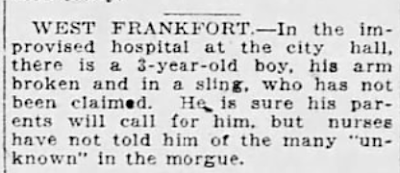
A particularly sad story was noted in a newspaper article.


"Storm Freaks," Herald and Review (Decatur), 20 March 1925, p.2, col.5.

After the storm, a downpour hit the devastated areas. Most of the streets were unpaved then, and the mud further impacted the rescue efforts. The Red Cross arrived the next day to distribute food and clothing and provide medical aid. The National Guard was deployed to prevent looting and help with the cleanup. Martial law was briefly instituted but not needed. Hundreds of families lived in tents for weeks after the tornado while housing was rebuilt. At the time, there was no formal disaster relief. Help came from private donations, charity, and fundraising. The mining companies helped to rebuild homes for their workers. 

Throughout the county, more than 150 people lost their lives, including at least 40 small children. Many people left the area after the storm and did not return. But the community came together to rebuild and recover. My grandparents moved to West Frankfort within a couple of years after the tornado — my dad was born there at the end of 1929. My grandparents remained there for the rest of their lives.

This week's #52 Ancestors prompt is Historic Events. 


Sunday, March 9, 2025

The Edwards Siblings and their Marriages!!!


This blog post was originally written ten years ago and I refreshed it for the #52Weeks Blog Challenge Prompt - Siblings.

My 3rd great grandfather HUGH H. EDWARDS was born in Kentucky in 1821 and married in Simpson County, Kentucky about 1848 to MARY HILTON. They are listed in the 1850 Simpson County, Kentucky census with their three-month-old daughter, Mary Jane. The couple moved to Williamson County, Illinois sometime between 1851 and 1856. 

Hugh and Mary had eight children, five of whom were daughters. Their daughters' marital trails proved to be interesting, complex, and confusing, partly because they married each other's husbands! Below is what I think is the tale of their marriages, with their brothers thrown in for good measure. [The underlined are the men who married more than one sister.]

Mary Jane Edwards was born June 1850 in Simpson County, Kentucky. She married Rufus Parker on 8 April 1866 in Williamson County, Illinois. Mary Jane died on 2 October 1907, freeing up her husband Rufus to marry her sister Jemima.

Jemima Edwards was born December 1851 in Simpson County, Kentucky. She married 1) David Winton Dunn, on 5 June 1879 in Williamson County, Illinois. They likely divorced by 1899 (Dr. Dunn went on to marry once or twice more). 2) James Davenport, on 20 June 1899 in Williamson County, Illinois. (He was husband of deceased Louisa A. Edwards) 3rd: 1908 Rufus B Parker (He was the husband of the deceased Mary Jane Edwards.) Jemima married two of her late sister’s husbands and collected Civil War Widow's pensions from both.

Louisa A. Edwards was born in 1859 in Williamson County, Illinois. She married 1) James Forbes 16 May 1878 in Williamson County, Illinois. 2) James Davenport, 24 December 1888 in Williamson County, IL. Louisa appears to have died before 1899, leaving her husband James free to marry her sister Jemima.

America Elvira Edwards was born in 1861 in Williamson County, Illinois. She married Samuel Minter Beasley on 25 February 1863 in Williamson County, Illinois, and died in June 1917. She appears to have had only one husband, and he appears to have married only one sister. Her brother Henry Scott Edwards did, however, marry a family connection.

Lucy Margaret Edwards was born in June 1872 in Williamson County, Illinois. She married Robert Summers on 25 October 1893 in Williamson County, Illinois. Lucy died on 14 November 1930, having had only one marriage.

Lest you think the boys didn't have some interesting marriages....

Richard Edwards was born in May 1856 in Williamson County, Illinois. He married Martha S. Rains, 6 June 1875 Williamson County. She was the daughter of John Rains and Elizabeth Armes.

Sylvester Edwards was born on 18 March 1861 in Williamson County, Illinois. He married Sarah F. Rains, about 1886 in Williamson County. She was also the daughter of John Rains and Elizabeth Armes. Sylvester and his brother Richard married sisters. Sarah died about 1896 and Sylvester married a second time.

Henry Scott Edwards was born in March 1870 in Williamson County, Illinois. He married Nora Beasley on 4 April 1894 in Williamson County. Nora was the daughter of Wilburn Beasley, who was the brother to the above Samuel Beasley who married Elvira Edwards.

Why did these siblings do so much intermarrying? They lived in a small area of Williamson County, likely attending the same schools and churches. As a close-knit family, they didn't look far for spouses. 


Wednesday, February 26, 2025

Family Secrets? Or Stories Never Told?

We all have secrets in our family. But it's often the story that wasn't told and not some deep, dark secret. Judy Russell has a great talk about how knowledge can be lost in just a couple of generations. Regardless of how incredible it is, the story doesn't get passed on. Or it becomes like the game of telephone. It starts as the true story and ends up garbled and something totally different than the original.

My family is no different. The story of the family members who fought in the various wars was never passed down. The stories of their immigration to this country weren't discussed. None of these things were kept secret -- they just weren't shared. 

But we did have a couple of family secrets. 

A good example was learning that my great-grandfather, Albert Butzek, was a step-great-grandfather. No one talked about the fact that my great-grandmother had been married and divorced previously. Her first husband was the father of my grandfather and some of my aunts and uncles. This was unimportant to them since they considered Albert to be their father. As a genealogist, It was crucial to me to ensure I was tracking the right family. It wasn't that it was a deep dark secret. It just wasn't talked about, and there was an assumption that everyone knew about it. Well, I sure didn't.

After researching for a couple of years, I learned that my grandmother, Florence Halliday, had been married before she married my grandfather and had a child with this first husband. Imagine my surprise in learning that my dad had a half-brother that was never talked about. He had some challenges. It's unclear if they were physical or mental, but he died young, making it easier to keep him a secret. 

Divorce was definitely a taboo. So it just wasn't talked about. And things that aren't talked about, get forgotten. They become family secrets, hidden for generations, waiting to be uncovered by genealogists!!! 

This week's #52Ancestors Prompt is Family Secrets!


Wednesday, February 19, 2025

From New York to California -- Harrison Greenwood's Migration


This week’s #52Ancestors prompt is Migration. Harrison Hiram Greenwood is a perfect example of many who migrated within the United States, moving from one side of the country to the other.

Harrison Hiram Greenwood was born 1 April 1814 in Cortland County, New York, most likely in Solon. The son of Simon and Rebecah (Kenney) Greenwood, Harrison seems to have used the name Harrison most of the time but used the name Hiram in the 1870 census. At some point before 1835, he married Clarissa Welch, the daughter of John S. Welch. Harrison’s brother Moses married Clarissa’s sister, Sarah, around the same time. Harrison and Clarissa’s first child, Hiram, was born in Cortland County in about 1835.

Between 1835 and 1840, the family moved to Medina County, Ohio. Clarissa’s parents had migrated to nearby Wayne County. Three children were born in Ohio: Betsey Ann, about 1840; Margaret Ann, about 1841; and Sarah, about 1843. The family next packed up and moved to Rock County, Wisconsin, where their daughter Rosetta was born between 1847 and 1849.

By 1860, they had moved again to Owatonna, Steele County, Minnesota. This is where Rosetta married John B. Norman in December of 1866. They remained there until shortly after 1870, when Harrison and Clarissa packed up and made their most significant move – to Placerville, El Dorado County, California. This would be Harrison’s last move, as he died there in February of 1874. Clarissa remarried and lived until 1900, dying in Tahama County, California.

Harrison seems to have owned land wherever he went. But it’s unclear why the family made these moves. Perhaps it was for better land. Maybe it was just wanderlust. More needs to be uncovered about the Greenwood family.


The Greenwood family is not my family but belongs to a friend whose family I’m researching.

Wednesday, February 12, 2025

"Writing These Few Lines"

This week's prompt for #52Ancestors is Letters and Diaries

I am not lucky enough to have many letters from relatives. In fact, I have precisely one—a copy of a letter from my second great-grandfather, Alexander Clark, in Iowa to an old friend, C.B. (Charles) Reddie, in Brazil, Indiana. It's unclear how they knew each other—perhaps they arrived in the United States together or knew each other in Scotland. They were both coal miners; based on the letter, they knew each other's families. C.B.’s wife, Isabella Graham, was born in County Fife, as was Alexander, so perhaps that was the connection.

The letter, dated 16 December 1895, was written in Clarkdale, Iowa, and sent to C.B. Reddie of Brazil, Indiana, in response to a letter that C.B. had sent.

“Of course, you will find a great change from your former way of living, but these things must be put up with.”

Something had happened in C.B.'s life that changed it —his wife had died in August 1895  Charles was a new widower. Alexander mentioned that they received the photos that were sent and he noted “You have better stood time well as far as looks go. Well I hope trade is good with you and keeping you going and help to keep your mind from other things.” This seems like something an old friend would say to comfort a grieving widower.

“Work is going slow here. Trade seems at a stand still. No one seems to be using any coal this winter. I think the coal trade is played out in this part of the country. We hardly make as much as clear expenses  but then we will best have to put up with it. I hope for better times.”

Besides working in the coal mines at an early age, Alexander Clark and his family owned a small coal mine in Appanoose County, Iowa. It’s unclear what years they had this mine and how large it was, but they were concerned about the coal industry. A major strike had occurred the previous year, and the effects were still being felt. As a small mine operator, they faced competition from the mines in southern Illinois. Unionization and mechanization were growing, which likely also affected the mine operation.

Then Mr. Clark went on to talk about his family.

“Alex, John & Charles are all dead & gone. George & William are married & live here beside us. George & wife has 2 children, 1 boy & 1 girl. William & wife has 6 children, 1 girl and 5 boys. Grace & Maggie [my great-grandmother] are married & live at WhatCheer. Grace has 1 girl & 2 boys. Maggie 1 girl. James & Isabella are still unmarried & live at home with us. Alex left one boy & he lives with us. He is 13 years of age. John left 5 children 3 boys & 2 girls. They live with their mother in Mystic. Alex was killed in the Pit at WhatCheer. John died of Typhoid fever in Mystic. Charles was killed by lightning standing speaking to his mother in the door about 3 years ago. He was 17 when he died. So you see we have all our little troubles in life. And when death comes we have rest from them all.”

He finishes his family talk with the following:

“I was 61 years old yesterday. I am not able to work very hard now but still I get along very well. Mrs. Clark has got a cold in her back which pains her bad at present but I think it will soon get better again.“

Mrs. Clark lived until 1903, and Alexander Clark lived until 1912.  He closed his letter somewhat pessimistically – or perhaps he was being a realist.

“Wishing you all as Merry a Christmas as it is possible for you to have under the circumstances. There will be a great want this time.”

And he signed off:


I loved reading this letter for so many reasons. First, it’s a genealogical goldmine!! But secondly, this is a man I know very little about. Born out of wedlock, he was in the coal mines at a very early age. He and his family journeyed to the United States, hoping for a better life. He seems to have written this letter very matter-of-factly, and I get the feeling that, regardless of the troubles he’s seen, he is proud to have his family around him. 


Friday, February 7, 2025

Surprise in a Pension File

 This week's #52Ancestors in #52 Weeks Prompt is Surprise

A recent find in a pension file was quite a surprise. There are many stories about pages from a Bible or other originals included in a file as proof of some event. I've never encountered such a thing until now.

John C. McDowell (1784-1861) served as a Sergeant in Captain James Dennison's Company of the Pennsylvania Militia during the War of 1812. His widow, Susannah Vaughn McDowell (1792-1876) filed for a Widow's pension after John's death. It is 50 pages long and will likely be filled with great information. But the surprise that caught my eye was a "Certificate of Birth and Christening" for a son born in 1815. Besides the lovely decoration, Susannah's maiden name is also included. 

This decorative certificate was definitely a Surprise!!!


Saturday, January 25, 2025

HE Was the Oldest Son - Overlooked

Although the oldest son, George Sampson was often overlooked!!

George A. Sampson was born on 8 June 1869 in Excelsior, Hennepin County, Minnesota.[1] The second child and oldest son of Leroy Francis and Eliza (Spaulding) Sampson, he lived with his parents and siblings in Excelsior and Chanhassen. His parents were born in Maine and Rhode Island, so he had deep roots in New England, as did many others in the area.

George's life was cut short at an early age when he died on 9 September 1890 in Excelsior, having never married. His cause of death was given as traumatic tetanus, which likely resulted from a puncture wound. He was working as a clerk at the time, so it seems unlikely that it was an on-the-job accident.[2] 

In 1890, there was no cure or prevention of tetanus, and it was usually a death sentence, killing 85% of those infected. Tetanus was incredibly painful. It caused muscle stiffness, including "lockjaw," muscle spasms, and difficulty swallowing and breathing. Usually treated with morphine or opium, patients were kept in dark, quiet rooms and sometimes fed by a feeding tube. There was little the doctors could do, and all the family could do was watch him die a painful, likely protracted death.[3]

George was just 21 years old when he died, barely a man. Yet his younger brother Walter was often described as the oldest son of Leroy and Eliza.[4] And while technically, after George's death, this was true, it still feels like George was "overlooked" in this description. Walter would have been better described as the oldest "living" son of Leroy and Eliza. 

The Sampson family was close-knit, so perhaps the loss of young George was just too much, and the family chose not to mention him. While others may have overlooked him, I suspect his parents never stopped thinking about their young son, lost to a disease that would soon be preventable and curable. 

This week's prompt for #52 Ancestors in 52 Weeks was Overlooked!

______________________________________________

1 No record of his birth has been found. The date is calculated from the age given on his death record.

2  “Minnesota County Deaths, 1850-2001,” digital image, FamilySearch (https://www.familysearch.org/ark:/61903/1:1:QPS1-ZPPV : accessed 18 January 2025); entry for George A. Sampson, Hennepin County, 9 September 1890. FSL DFN 7552565, Image 1100.

3 Battling Tetanus, Smithsonian  online article https://www.si.edu/spotlight/antibody-initiative/battling-tetanus?utm_source=chatgpt.com: accessed 19 January 2025.

4  “Minnetonka, The Minneapolis Journal, 11 April 1901, p.5, col. 5; digital image, newspapers (https://www.newspapers.com : accessed 19 January 2025).